
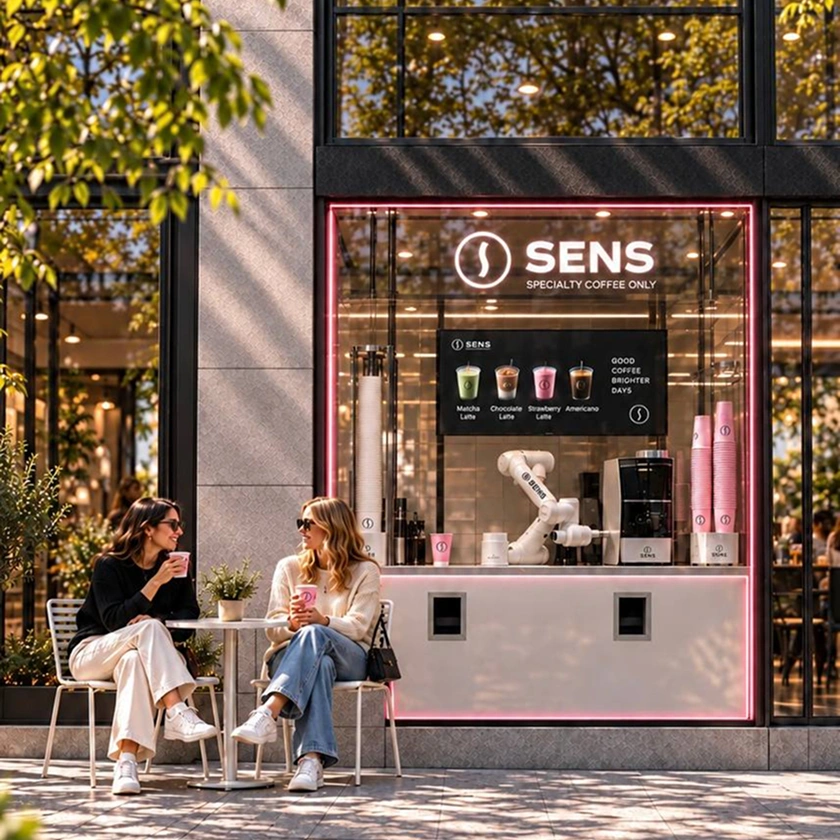
Our top priority: a busy sidewalk
We look first for a strong, regular flow of people walking directly past the proposed coffee window. A prominent storefront on an active pedestrian route gives passers-by a chance to see the menu, stop and order from the street.
Tell us when the sidewalk is busiest on weekdays and weekends, what brings people to the area, and whether the window is visible and easy to approach. Passing cars or a busy neighbourhood alone do not tell us how many people walk past your exact frontage.
If you have pedestrian counts, include the number, observation period and time of day. If not, you can still apply: share the address and describe the activity you see. SENS reviews pedestrian flow and site suitability before proposing a partnership. High foot traffic does not guarantee sales or income.
Earn a share of coffee and matcha sales
The proposed host model offers 10–15% of SENS Spot sales revenue, subject to the location review and your written agreement. This is a share of the coffee service’s sales, rather than a share of its net profit.
Your agreement defines the exact rate, treatment of sales tax, refunds and discounts, reporting, payment schedule, utilities and installation responsibilities. Host income depends on actual sales; no minimum income is promised.
Keep your business. Add a coffee destination.
SENS Spot serves customers through a street-facing ordering and pickup area, with the equipment installed inside the premises. Your bakery, shop or service business keeps its main purpose while adding a complementary reason for people to stop.
A coffee visitor may discover your products, and your existing customers gain another reason to visit. Extra foot traffic and cross-purchases are opportunities to measure, not guaranteed results.
Bakeries and pastry shops
Pair your pastries with specialty coffee and matcha, especially where you do not already offer a full drink menu. Review existing beverage agreements before adding the service.
Frozen yogurt and dessert shops
Offer another choice for companions who want coffee or matcha, and introduce coffee visitors to your desserts.
Retail stores and street-facing offices
Explore an underused frontage at a clothing store, showroom or service office. A premium coffee stop can introduce people to the business behind the window; it does not guarantee enquiries or sales.
You host the space. SENS runs the coffee service.
You provide the agreed frontage and interior space, permission to use it, and the site access and utilities set out in the agreement. SENS plans the installation and manages the agreed daily coffee operations, including replenishment, cleaning, maintenance and customer support.
Your staff do not need to prepare the drinks or run the daily coffee service. Before work starts, the proposal identifies who pays for fit-out, power, water, any building work and site-specific approvals.
A suitable opening starts with a site review
High pedestrian foot traffic is the first screening priority. We then assess the street-facing window, storefront glazing or suitable door opening, together with the space inside. The opening must not obstruct an entrance, emergency exit or accessible route. A long-term tenant can propose a space where the lease and any required landlord consent allow the arrangement.
There is no universal minimum space or promise that every opening will fit. Send the opening’s width and height, the usable interior depth, frontage photos and a floor sketch. We check equipment clearances, servicing access, customer queues, weather exposure, security, power, water and drainage before confirming feasibility.
Trading hours depend on street access, the property, service coverage and applicable approvals. Existing images illustrate the concept; they are not approved plans for your property.
Understand the host revenue share
For illustration only: if the contract-defined monthly sales base were $10,000, a 10% host share would be $1,000 and a 15% share would be $1,500. These are arithmetic examples, not sales forecasts or expected earnings. Any host expenses are separate.
The next step is to assess whether the location can support the service, then agree the terms using a clearly defined revenue base.
Propose your storefront in three steps
- Introduce the space. Start with the address and pedestrian activity directly outside your storefront: busiest days and times, nearby destinations and any observed counts. Add your business type, ownership or lease status and approximate dimensions.
- Review the location with SENS. We discuss photos, layout, permissions, utilities, service access and the fit with your existing business.
- Agree the partnership. If the site is suitable, confirm the revenue share, installation responsibilities, operating scope and payment terms before installation.
No ready-made location plan is needed to start. Request a review, then send photos in reply to the SENS team.
Propose my storefrontQuestions from host businesses
Do I need to buy a RoboCafé?
This enquiry is for hosting SENS Spot at your premises, with SENS operating the coffee service. It is separate from buying and operating a RoboCafé. The proposal sets out any host contribution or installation costs.
Can I apply if I rent the premises?
Yes. Tell us how much lease term remains and whether you can obtain any required landlord consent. The arrangement may be a licence, concession or sublease depending on the agreed structure; permission must be confirmed before installation.
Do my employees need to refill and clean it?
Daily coffee service is managed by SENS under the agreed scope. The proposal defines access, servicing and any tasks or costs that remain with the host.
Can you assess a bakery, dessert shop or showroom?
Yes. We assess the actual frontage, traffic, service coverage and fit with your business rather than accepting a site based only on its category.
Is the host payment guaranteed?
No. The share is based on actual sales and your agreement. Ask how you will receive sales reporting and how payments are calculated.